Decided, not delivered

On 3 November the Reserve Bank Board raised the cash rate for the fifth time this year, to 4.85 per cent, the highest since 2008. The Bank’s forecasts, published the same day, have headline inflation peaking at 4.5 per cent and staying above 3 per cent until late 2027. Five rises this year, each taken by one body with full authority, and the inflation they were aimed at is still there.
Most decisions that fail are held up by others with the power to stop or hold them. Nobody holds the Board’s decision. It is taken on the day, announced to the minute and in force the next morning. If it does not deliver, the fault is not in who decides. It is in whether the decision has a path to the prices it is meant to move.
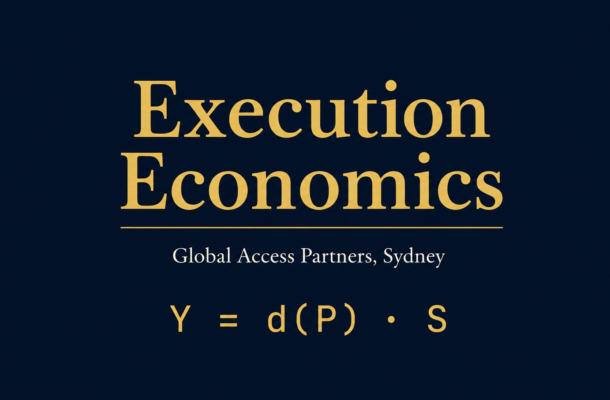
Execution Economics reads that path. It treats an outcome as the quality of a decision multiplied by its sovereignty, and follows the decision from where it acts to where the result is meant to land. A rate rise acts on borrowers. It reaches the prices of firms whose customers borrow, because those customers buy less. It does not reach prices set on world markets, prices set by governments and institutions, or the cost of energy. Read by who sets each price, the index divides into prices the rate reaches and prices it does not.
Five times since 2023, inflation moved for reasons the rate does not reach while the rate was moving too.
From June 2023 to June 2025 inflation fell. World prices, shipping and building costs eased, electricity rebates began, and the large rises of 2022 dropped out of the annual comparison. The fall was read as policy working. About four-tenths of it came in prices the rate reaches weakly or not at all, and a fifth in housing. The rest came in domestic businesses, where no price effect of the rate is measured within two years.
By mid-2025 the underlying measure, the quarterly trimmed mean, was down to 2.7 per cent. The rebates were holding electricity prices down. The Bank read policy working, and cut.
By the end of 2025 the underlying measure was back to 3.4 per cent, against the 2.8 the Bank had forecast in November 2024. The rebates had ended on a date set in the Budget, and electricity rose 21.5 per cent over the year to December. The Bank read demand, and raised four times in 2026 before this week.
In the year to September 2026 prices set by domestic businesses rose 3.3 per cent, read by the Bank as capacity pressure. Those prices follow energy: a 10 per cent rise in oil lifts them about half a per cent within a year, and the oil rise that took pump prices up 23.6 per cent accounts for their whole gap above 2.5 per cent.
In September rents slowed, read as higher rates cooling the market. Rent Assistance had been indexed, which the Bureau records as lower rents. The call lodged on 27 October 2026, the day before the release, had rents slowing; they rose 0.20 per cent in the month, against a June to August monthly average of 0.33.
Each time the movement was misread: the falls credited to the rate, the rises blamed on demand. The Bank’s forecasts allowed for supply pressures to ease, so their accuracy on the way down was not luck. What the record does not support is the credit given to the rate.
The Bank’s reply is that rates work with long and variable lags. An effect the Board cannot see in time is an effect it cannot steer. A decision whose result can be credited only after the conditions have changed is not being delivered. It is waiting for something else to move.
None of this questions the Board’s resolve or competence. What the decision lacks is a channel to the prices now driving inflation, and raising the rate again does not build one. It presses harder on the prices the rate can reach, while the prices it cannot reach go on rising.
Execution Economics does not ask whether the Board should have raised the rate. It reads whether the decision can arrive. For the prices now driving inflation, on the record, it cannot.

Peter Fritz AO is Chairman of Global Access Partners and Group Managing Director of TCG. He chairs a number of influential government and private enterprise boards and represented Australia on the OECD Small and Medium Size Enterprise Committee.