Four rate rises this year, and prices are rising faster

After four increases in the cash rate this year, inflation is rising, not falling. Headline inflation rose from 4.0 to 4.3 per cent, and almost all of that rise came from world prices, led by fuel.
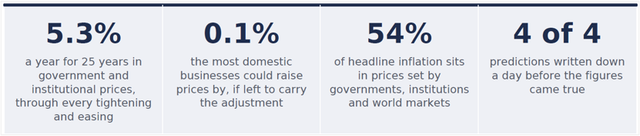
Execution Economics Global divided the ABS September CPI figures by who sets each price. More than half of headline inflation sits in prices set by governments, regulators, insurers, schools, hospitals and world markets. On the Bank’s monthly underlying measure, 0.44 of the 1.03 points above the middle of the target sits in prices set by governments and institutions, which the cash rate has no direct route to.
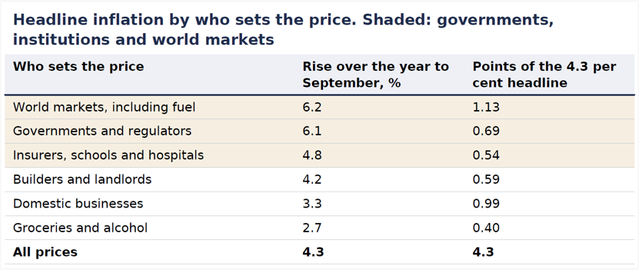
The arithmetic follows. If those prices keep their present pace, everything else must slow to about 1.9 per cent for the Bank to reach its 2.5 per cent target, below the bottom of its own band. If the work is left to the businesses the cash rate actually reaches, their prices would have to all but stop rising: no more than about 0.1 per cent a year.
“This is not a want of resolve at the Bank,” said Peter Fritz AO, co-creator of Execution Economics. “The rate reaches customers, builders and firms. It does not reach the Health Minister’s premium approval, the fuel excise or the council rates notice, and that is where much of the excess sits.”
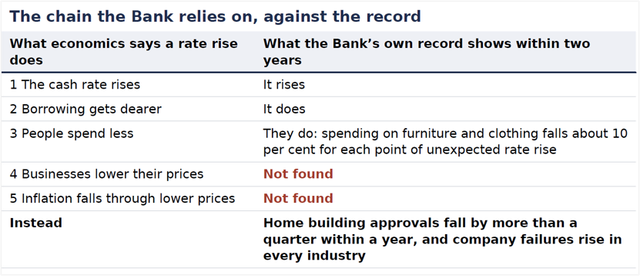
What the Bank does not see
The Bank reads inflation as one number, after the event. Its framework has no step that asks who set each rising price, or whether the cash rate can reach that decision. Read that way, the pattern is plain.
For twenty-five years, government and institutional prices have risen about 5.3 per cent a year, through every tightening and every easing, while prices set by domestic businesses rose about 2.5. And two-fifths of the fall in inflation from 2023 to 2025, the fall credited to the rate rises, came in prices the rate reaches weakly or not directly at all.
Today’s domestic prices follow energy. Fuel rose 23.6 per cent over the year and electricity 12.8 per cent. On the record since 1998, a 10 per cent rise in oil prices lifts the prices of cafes, trades, retailers and services by about half a per cent or more within a year.
Who pays?
Company failures reached 14,722 in 2024-25, and 64 per cent of the failed firms had fewer than five employees. A $600,000 mortgage costs about $366 a month more than in January. None of these households or small firms sets the prices that are rising fastest.
Predicted before the figures came out
Four predictions about today’s figures were written down a day before the release, each with the result that would prove it wrong.
“We wrote down our predictions a day before the figures came out, and every one came true,” Mr Fritz said. “Who sets each price can be seen before the Board meets. That is the time to look, not two years later.”
“A fifth rise asks the businesses that set their own prices to carry the ones they do not set,” Mr Fritz said. “The cash rate’s job is cooling overspending. The rest of the excess has names on it, and they are in Canberra and the state capitals.”
What should happen now
The Reserve Bank Board should hold the cash rate at 4.60 per cent on 3 November.
The Commonwealth should pause fuel excise indexation while the oil shock lasts, phase electricity rebates out gradually, and weigh the next health premium round against inflation.
The states and councils should hold charges set by formula, and release land and approve building faster.
The Treasurer and the Bank should publish inflation by who sets each price, alongside the trimmed mean.
Sources: Australian Bureau of Statistics, Consumer Price Index, Australia, September 2026; Australian National Accounts: Input-Output Tables; Reserve Bank of Australia statistical tables, including Table F6 lending rates; Australian Securities and Investments Commission, Insolvency Statistics; World Bank, Commodity Price Data.
Method: each of the 87 expenditure classes is assigned to the party that sets its price, and the Bank’s monthly trimmed mean is rebuilt from the classes, to within 0.003 of a percentage point, and divided by those parties. The 1.03-point excess is measured on the sum of the twelve monthly figures to September. On the quarterly trimmed mean, which rose from 3.6 to 3.7 per cent, the same prices hold 0.42 of a 1.17-point excess and the rest must run at about 2.0 per cent.
The 1.9 per cent assumes the institutional prices keep their present rates and the trimmed mean’s weights are held as they are; the 0.1 per cent is on the monthly measure, and 0.4 on the quarterly. The mortgage figure uses the average owner-occupier variable rate, 5.5 per cent in January and 6.2 per cent in July, with the September increase passed on in full.

Execution Economics Global, based in Sydney, applies Execution Economics to public policy, markets and investment. It reads each outcome by who takes the decision behind it, whether a policy reaches that decision, and who has to act, and it sets down its predictions before the data arrive.