The birth of Execution Economics

A discipline in search of its identity
Economics has spent a century and a half deciding what it is about. It has been the study of wealth, then of choice under scarcity, then of incentives, then of everything from marriage to parking fines, and lately of anything a large enough dataset can be made to explain. Each of those was a real answer. None of them settled the question, and a discipline that keeps announcing its subject is telling you something.
What it has never quite been is the study of whether anything actually happens.
That sounds unfair, so let me be exact. Economics measures what could be produced with real precision. Capital, labour, productivity, elasticities, optimal prices. No discipline does that better. What it does not measure, anywhere in its accounts, is whether a decision taken on Tuesday reaches the ground by Friday. Arrival is treated as automatic, or as noise, or as somebody else’s department, usually management.
For most of the twentieth century you could get away with that. When working out what to do is hard and expensive, the scarce thing is knowing. Now knowing is cheap. Everybody has a plan. Very little of it lands.
The evidence that something was missing
You can hear the gap in the literature if you know the sound. Four examples, all from serious people, all wrong in the same direction.
Robert Solow subtracted capital and labour from growth in 1957 and found that seven eighths of it was explained by neither. He called the remainder technical change. Moses Abramovitz had already named it correctly the year before. He called it a measure of our ignorance, and he was the last person in the field to describe it accurately. The discipline renamed the ignorance, gave it an acronym, gave it journals, and has been selling the name ever since.
Robert Lucas told the American Economic Association in 2003 that the central problem of depression prevention had been solved for all practical purposes. Five years later Lehman Brothers filed and the Queen went to the London School of Economics to ask why nobody saw it coming.
For thirty years a large and careful literature computed the optimal price of carbon to the decimal. Eighty pricing schemes are now running worldwide. They cover about 28 per cent of emissions at an average near nineteen dollars a tonne. Holding warming to two degrees implies sixty-three to a hundred and twenty-seven. Under 1 per cent of the carbon burned on this planet is priced anywhere in that range. The shortfall was filed under politics rather than under a defect in the advice.
And then there is Paul Krugman, who in 1998 wrote an article titled Why most economists’ predictions are wrong. In it he predicted that the internet would slow down and end up mattering about as much as the fax machine, on the grounds that most people have nothing to say to each other.
He was right about the premise. Most people do have nothing to say to one another. What he missed is that saying nothing, at sufficient scale, is one of the largest industries ever built, because a pipe does not care what goes through it. He was also, at that moment, one of the very few economists alive with a transmission term inside his own model. He won a Nobel Prize for it ten years later. The man had the answer in his desk drawer and used the other drawer.
19 December 2025
I was in my study. The idea came there, and I went down the steps to find my wife and tell her, still in the middle of it, that I had found something.
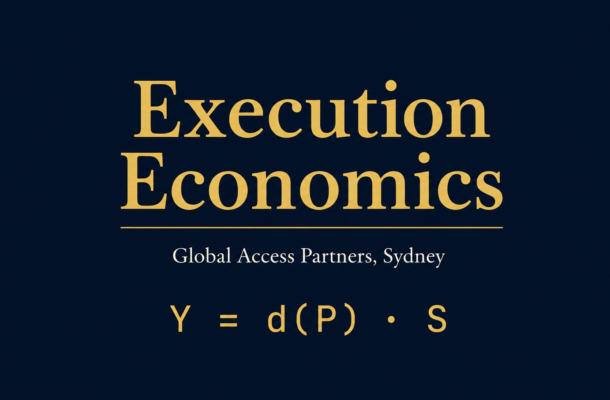
Y = d(P) × S
Output equals the quality of the decision, multiplied by a second thing. There will be no more notation than that.
Multiplied. Not added. Which means that if the second thing is zero, the finest decision ever taken produces nothing at all, and no improvement in the decision will rescue it. You can be right and still get nowhere, and the arithmetic says so rather than the sermon.
This is not friction and it is not luck. We came to call it decision sovereignty, which is a heavy name for a plain idea: the extent to which the person who decides is in a position to have the decision carried out. Sovereignty is a property of the arrangements in place on the day, which means it exists before the outcome does, and can be measured in advance. And a measurement taken in advance can be wrong. That last point is the whole of it. If you work a number out after the event, using the event, it can never be shown up. If you write the number down first, the world can prove you wrong. Only the second kind tells you anything.
Four questions, and how they fit together
Sovereignty is read by asking four questions about one decision, on the day it is taken.
Who decides. Does the person taking this decision actually have the right to take it, and will the people who have to act accept that.
Who can change course. Do they command the means. Can they start it, stop it and fix it, or does that sit with somebody else.
Who can see. Can they find out what is really arriving, in time to do anything about it. Not what was spent. Not what was announced. What turned up.
Who can block. Who is able to stop or reverse this after it has been decided, and how likely are they to use that power.
The first three work like the legs of a stool. You need all of them, and the shortest one decides how far the thing tips. Having plenty of authority does not compensate for being unable to see. Perfect information does not help a person who cannot move the levers. They multiply rather than add, and the weakest of the three sets the result.
The fourth works differently. A veto does not join the stool, it takes away part of whatever you had. Somebody else holds a key to the handbrake. You may have authority, control and clear sight, and still be pulled up by a person who was never in the room.
Together they give a number between zero and one, with a direction attached. This is not a judgement about whether the plan is any good. It reads whether this particular decision, taken by these people, under these arrangements, stands a chance of being carried out.
The suspects
Any decent detective story has a moment where you realise the clue sat on the table the whole time, and that several intelligent people picked it up, turned it over and set it back down.
Ronald Coase asked why firms exist and answered that using a market costs something. He priced the deal. He did not ask whether the deal, once struck, ever happens.
Elinor Ostrom came from outside economics and showed that the arrangements people make, rather than who owns what, decide how things turn out. She got closest of anyone, and she got there by going and looking at irrigation ditches, which is a lesson on its own.
Friedrich Hayek showed that the knowledge needed to run an economy is scattered among the people on the spot, and that no central planner can ever gather it up. He used that to explain why prices work and why planning does not. What he never did was turn the same question inwards, and ask whether the knowledge reaches the person inside an organisation who actually has to act on it.
But the one I keep coming back to is Nogales. Daron Acemoglu and James Robinson, who shared the Nobel Prize in 2024 for their work on how institutions shape prosperity, open their book Why Nations Fail there, at a single city with a fence through the middle. Same desert, same families, same name. North is richer, therefore institutions. It has been taught in every development course on earth for over a decade.
Here is what is actually at that fence. The Mexican side holds about 264,000 people. The American side holds under 20,000. Nogales, Arizona is the second-poorest city in its own state, with a median household income around half the Arizona average. Whatever the fence is doing, it is not producing a rich town on the northern side.
And roughly eight billion dollars a year of output sits in a queue of trucks at that crossing, waiting to be processed. It is visible from the air. It smells of diesel and avocados.
Two of the most careful institutional economists alive stood beside the largest measured obstruction in the hemisphere and wrote a book about the rulebook. A rule permitting a truck to cross is not the same fact as a booth that lets it through by Thursday.
The part that was already thirty years old
It would make a tidier story if the whole thing arrived in the study that afternoon. It did not.
The fourth question, the one about who can block, is much older than the rest. Catherine Fritz-Kalish and I have been working on it together for close to three decades, long before there was anything to put it in and long before any of this had a name. It walked into the identity already formed, because two people had been arguing about it since the 1990s.
The rest came in the year that followed, and not from me. Olga Bodrova brought the finding that sovereignty does not simply improve as an institution uses it more. Push more decisions through the same institution and at some point less comes out, not more. That is counter-intuitive, it is correct, and it is hers. Armen Ayvazyan brought direction. A channel can deliver the opposite of what it was pointed at. Not weakly. Faithfully, efficiently and at scale, with nobody lying and every procedure followed. Robodebt was not a failure of capability. It was capability aimed the wrong way.
One of the four is mine. Anybody who tells you a thing like this comes out of one head is selling something.
Sixteen papers and one question
The discovery did not produce a book. It produced sixteen short papers, written fast, each taking one piece of the problem and pushing until it either held or broke. Nobody writes sixteen short papers to dress up an idea they already like. You write them to find out whether it survives being taken apart.
On 12 January 2026 I handed the papers to Olga Bodrova for registration. Late in January the three of us, Catherine, Olga and I, wrote the seminal paper for the last issue of the Journal of Behavioural Economics and Social Systems. The monograph came after that, in February, edited by Olga Bodrova.
What followed was about five months of twelve-hour days and a family who thought I had gone mad. In fairness, the evidence available to them supported that reading.
I want the arguing recorded as a contribution rather than an obstacle, because that is what it was. A claim like this needs somebody at the table demanding that it be justified, and then explained again in words that hold. Every time I had to answer for it, it came back sharper or it came back smaller. Both are progress.
And the question in the room, for a long time, was not whether the thing was clever. It was whether it was real. Catherine, Olga, Armen and I spent many hours on that. Not agreeing. Trying to work out what we had stumbled on, which is slower and worth a great deal more.
The rejections, which are the best part
SSRN refused to register any of the papers.
I have thought about this a good deal. A repository whose entire function is to accept documents declined to accept documents about things that fail to arrive. If the theory had needed a demonstration case, it received one free of charge, from an organisation with no idea it was providing it.
A New South Wales Treasury economist said he was not going to waste his time on this. I have kept that note. The shortest peer review I have ever received, and by some distance the most efficient.
There were many approaches and many polite declines. I mention them because a promotional piece would not. An idea assembled to impress does not accumulate a year of rejection and keep going. It gets dropped, quietly, and nobody writes an article about it afterwards.
Where it turned
ASE 2026 in Canberra accepted a speaking place, and Catherine and I presented the paper there. After the run of declines it felt like a small miracle. Catherine and I also made the trips to Tasmania for the early presentations, in rooms, in front of people, before any of it was settled.
Then came the introduction to the OECD, where the interest was enthusiastic rather than courteous, and which led to a presentation in Paris on 1 September this year. Dr James Rydge and Damian Hickey took an early interest and have kept it.
Somewhere in there it stopped being a thing I was explaining and became a thing other people were using. Nothing about that turn depended on whether anybody had blessed it.
For the record
I am eighty-three. I have built companies, and the thing I learned building them is that the distance between a decision and its effect is where everything actually happens, and that almost nobody measures it because it belongs to no one.
The claim is not that economics has been wrong. Most of it has been right about the decision and silent about the delivery, and silence is not error. The claim is that there are two things here and not one, and that every account computing with a single one is quietly assuming the second is perfect. Sometimes it is. Where it is, those results hold exactly as written. Where it is not, an account that leaves the term out can still match what happened, and the match was produced by something the account does not carry.
The word for that is luck.
A discipline in search of its identity might consider this. The thing it has been circling for a hundred and fifty years is not a better measure of what could be done. It is a measure of what will arrive, taken before the journey starts and before the money is spent.
Execution Economics was developed by Peter Fritz, Catherine Fritz-Kalish, Olga Bodrova and Armen Ayvazyan. The monograph “Decision Sovereignty: A Theory of Execution in Prediction-Rich Economies” was published in February 2026.

Peter Fritz AO is Chairman of Global Access Partners and Group Managing Director of TCG. He chairs a number of influential government and private enterprise boards and represented Australia on the OECD Small and Medium Size Enterprise Committee.